
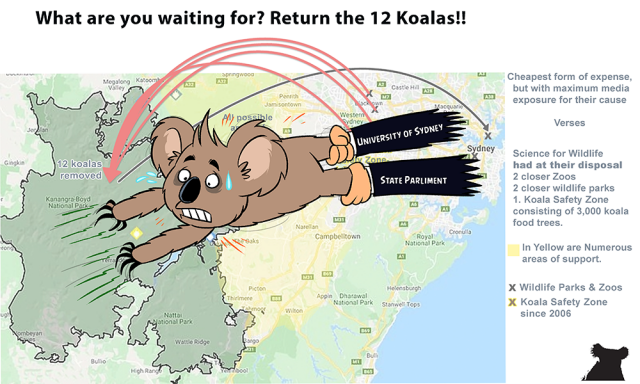
On 17 December 2019, while the bushfires were raging, the Sydney Morning Herald reported that Dr Kellie Leigh of Science for Wildlife (see http://scienceforwildlife.org), Taronga Zoo's conservation partner, had "rescued" a dozen koalas "from the bushfire-ravaged Blue Mountains and sent to Taronga Zoo, as an out-of-control blaze burned towards their habitat". (see https://www.smh.com.au/national/nsw/handful-of-blue-mountains-koalas-successfully-relocated-to-taronga-zoo-20191217-p53kth.html)
It is now 4 weeks since Sydney received over 300 mm of rain in one weekend, effectively extinguishing all our bushfires overnight. The question I have for Dr Leigh and her team: Why aren't the 12 healthy koalas being returned?
We are still in the best time of the year for koala food production and availability in the Blue Mountains, the home of the 12 koalas. Even at the time of heat and fire, it was the best time for food production and availability. The only thing everyone was waiting for was the level of moisture, with rain finally falling on the wet Friday, the 7th of February 2020, Saturday, the 8th of February, and Sunday, the 9th of February. It was basically the heaviest rainfall since the 1990s. The very next day after the first rainfall, and especially over those three wet days, the tree and native vegetation quickly reacted to moisture in the air as well on the ground.
So, why weren't the 12 healthy koalas returned the following week?
Sure, I understand, once you remove 12 healthy koalas from their habitat and put them in an environment that they are not accustomed to, you have to ensure their safety. However, once things change, such as now that the fires have been extinguished and there is new vegetation growth, a re-introduction back into the Blue Mountains would be the appropriate action. To my knowledge, this hasn't been done, nor talked about.
There has been a real window of opportunity to reintroduce the koalas back into their Blue Mountains and time is slowly diminishing as which week pass, the longer they eat from a foreign food source the harder its going to be for those 12 koalas to return home comfortability. For some personalities of those 12 koalas, some will fine is even harder to adjust back to a diet that they are accustomed to (at 1000 meters above sea level), rather than receiving the majority of their food supply from a foreign food source (at 50 meters above sea level).
Koalas eating at different sea levels is not that special in itself, as koalas have the ability to choose their preferred food source. It however takes time and an environment that is undisturbed, allowing the koala itself to determine what they can and can't eat.
A colony or group of koalas that enters a new space like Kanangra-Boyd National Park, Blue Mountains, enters the new environment slowly and at their own leisure and time frame. As they travel further into the new landscape, they slowly evolve into a specific area, (which takes decades) becoming a specialized group of koalas that generate unique in a physical and genetic abilities. Koalas are no different to other forms of life - other animals and plants - and their diverse evolution over time.
Separating the 12 koalas from the rest of their group, and for such a long time, is bound to affect them negatively, now in their foreign environment as well as and upon their return to their home.
The 12 koalas, as well as the other koalas of their group, are showing us "RIGHT NOW"! what evolution looks like.
It's disappointing that a Doctor of Science doesn't appear to understand that the timing of reintroduction is very important. And the fact they haven't been return demonstrate their inexperience how to do even this!
Dr Leigh doesn't appear to recognize the uniqueness of what these 12 koalas and their group presented. On the contrary, she has interrupted the evolutionary process by not allowing this particular group of koalas to evolve at their own pace.
Why can't a scientist see this?
This is what evolution looks like in the 21st century.
A koala group's survival and success depend on them slowly understanding and adapting to their new environment. This particular koala group is surrounded by mature trees that find it hard to develop strong new growth.
Competition between the trees, in this type of climate, and depending on the season, would be intense. It takes time to connect for both species, as a new group of animals entering the space where certain tree species dominate one area over another, they need that time to map it all out- mentally, which again takes time and experience as they age, according what best suits them- as they experience a range of reasons to move forward and back. All this experience is necessary to past it on to the next generation.
It takes time to develop a harmonious balance between koala gut flora and plant chemistry, as well as koala breeding rate and plant growth rate. This simultaneous slow adaptation of the two groups to each other, koalas and plants, is key for the survival of both species.
So, the fact the 12 Blue Mountains koalas and others who all contribute are slowly building their population is no different to koalas that are slowly evolving in other parts of NSW, and in fact all around Australia. They all show a different preference of food, due to dominance of certain Eucalyptus species in a specific area or region.
This is how a local koala colony adjusts their eating habits.
This time of the year, 'summer', is when the koalas' food is regenerating at a fast rate, even in Kanangra-Boyd National Park. While plant growth might not be as fast as in some other regions, this is the best time even for Kanangra-Boyd National Park.
It means there is a small window of opportunity to reintroduce the 12 healthy koalas back into their Blue Mountains – or very near their habitat. It need not be exactly the same place as before. After summer, we will slowly enter into a cooling phase of the year, with the mornings getting cooler, less light and weather patterns incrementally changing. As the seasons shift, so will the behavioural patterns of the koalas.
The aim should be for the 12 koalas to fit back into the domestic hierarchy within their own group and sub-groups. This was suddenly interrupted by removing the 12 koalas from their habitat. The longer the re-introduction of the 12 koalas into their old habitat is put off and the longer the koalas remain disconnected from each other and their group, the more it will cause unnecessary high levels of long term-stress and difficulty adjusting. And will Dr Kelly and her group take responsibility? Who knows as their no structure for an independent group to assess their behaviour!
Another perspective: The longer these 12 healthy koalas spend time in a foreign landscape on a different diet, the harder these koalas will find it to return to the thick leaf diet of the Blue Mountains.
These Koala's would endure internal stress in their internal organs, such as the kidney and possible their liver as they have a slow struggle under the constant pressure of living in a remote place such as the Greater Blue Mountains in the Kanangra-Boyd National Park, where the evolution process of the 12 koalas and others is taking place.
These 12 koalas health koalas missed their breeding season this year, because of human intervention, when the two major institutions (State Government and the University of Sydney) made the emotional decision that it was bad for the 12 koalas to be left in the National Park.
The koalas themselves would have not passed judgement on their environment. They would have accepted it and dealt with it. The strongest would have survived, and the weakest would have died. This would have allowed the passing down of stronger genes to the next generation who would have been better off than their parents before them. This is how it's meant to be, as assimilation between plants and animals occurs.
The real question is: Were the 12 koalas 'rescued', or was it a case of intergalactic space aliens probing these koalas TAKEN for scientific purposes and self-interest? The capture interrupted the natural order of this particular most unique group of koalas. It takes AWAY decades of survival instincts, if not hundreds of years before that, from a virgin group of koalas from forming into a new group of Sub-species, in a particular harsh environment, who are slowly adapt to a new environment, and taking away valuable insight in how they did it!
The longer the 12 koalas stay in the foreign landscape, in the captive environment, the harder it will be for some koalas to accept going back to their home range. The captivity diet is easier to digest, as it's full of soft Eucalyptus leaves. Some koalas with specific personality traits will find it hard to accept going back to harder leaves found in the Blue Mountains, little thinking how their gut flora may have change! Maybe for the better? Who knows! But the fact none of these facts were considered, just show this extraction was base on emotion rather then logic.
Handing over the 12 koalas to the captivity environment will have consequences. If it's not negatively affecting their physical health, it will definitely affect their mental state of mind.
Koalas coming from a free-range environment have different behavioural traits, to koalas held in captivity, and the methodology of caring for them should be very different.
Dr Leigh, an experienced scientist, the leader of her own research, has shown her skills with the platform she's created. But as soon she'd made senior connections with uneducated politicians, when making her statements to the NSW Koala Inquiry, her work became guided by self-interest. It became her natural instinct to control her environment that appeared to be slipping from her grasp.
It's similar to these 12 healthy koalas and other koalas who were lucky not to get pick up, who have their own major platform in the Blue Mountains. They also have their struggles within their own environment which is their major platform. They too have daily issues in their day-to-day lives. They too need to compete amongst other animals for survival and jostle for position in their own hierarchy group, we all do! including Dr Kelly who trying too hard to make a name for herself, her platform is trying to stand out from other scientist, all create an opportunity for her major sponsor the University of Sydney, to keep students rolling in and out of the system, maintain that commerce structure.
This is no different to the way we all live in our own environment and the way institutions such as the NSW State Parliament and the University of Sydney operate, jostling for position and creating drama, in a normal situations in order to out do one another, but when a great threat comes- an opportunity is created emotions must stay calm, but by dragging the 12 healthily koalas out of the Mountains, gave an unexpected prize win, in terms of using this situation to create revenue from donations.
The behaviour of Dr Kelly and her team all round was too hard, no soft way in their extraction, not even considering Lithgow, where there's a known koala food plantation and find out others means to support koalas in the Blue Mountains rather than run back to the city!
There has to be a better way, where decision making needs to be more structured, maybe she is putting too much pressure on herself, it's the Australian way, we are known too work hard. There was no soft extraction, if it need they needed to be extracted in the first p[lace. I'm wondering how the return is planning out, if her team and Taronga are waiting for the right time for regrowth its right now! We're on our way out of tip and regrowth, so the time is now for a soft return.
AFTER I Published my article on my website on the 10th of March 2020,
it took 'Science for Wildlife' only days to return the 12 koalas and one joey.
They returned the koalas on 23 and 25 March. In my view, the timing appears to show that they had really no idea when the best time to return of the koalas.
Why have I formed this view? It's the first time I've heard of a scientist to behave in this way for one. These koalas are unique due to their isolation and due to them living in a habitat of very old trees in the Blue Mountains.
To understand where I'm coming from: I am a professional who is feeding a number of different wildlife parks and zoos at the same time, and every koala populations is different with different environments. And at times in terms of their dietary behaviour koalas show that they can all become in sync, then thou are all live in different environments, with different levels of staff, regarding their confidence and work experiences. When you strip it right down- all the differences between one wildlife park to a zoo in terms of operational, skill and ego levels of staff and the controlling factor of certain individuals in the park itself.
Koalas can give off certain signals- that with a certain type of workmenship in the captivity sector- all supports my theory- why i think Dr Leigh had no idea -when it was the best time to return those 12 koalas, and then remove them from their own environment to begin with.
I would also love to challenge the claims made by 'Science for Wildlife' that their volunteers helped supply browse (koala food) for 3 months straight to support Taronga Zoo! I did something similar to what Dr Leigh claims her volunteers did.
In my view, Dr Leigh's actions of extracting the koalas from their natural habitat in the Blue Mountains was uncontrolled. My consultation with Taronga Zoo was only weeks earlier, and I feel it's an insult to my profession to allege that Dr Leigh's volunteers contributed anything meaningful. It's a common mistake and misconception that koalas must be fed from their area of origin, when they have been removed in such a dramatic way.
The extraction of the koalas from the Blue Mountains was undertaken in such a dramatic way that, in the end, it didn't matter that the browse they were fed came from their original habitat. Of course, every situation is different, but the way this particular operation was organized, in my view, shows inexperience. In the end I would guess that Taronga Zoo would have supplied 95% of the browse, and that only a small contribution of browse came from the volunteers.
It requires a certain amount of experience and field knowledge to know that you don't need to match the koalas' old diet with their new environment, in particular when it comes to such a unique set of koalas coming from such an isolated area.
The first thing you do is assess the koalas' new behaviour and allow starvation to slowly kick in. It's like going from Sydney to some small remote town in Botswana. When koalas come into a new environment under new management, it comes down to the experience and skill of staff to match the quantity and quality of the new browse to the koalas. As the koalas form a new connection to their captive diet and their new environment, new behaviour traits are created that differ from the koalas' traits in their normal habitat.
This is a great advantage of a captive environment. When we get it right, we get right! In a captive environment, we have a number of browsing techniques at our disposal. Unlike those working in free range and other conservation environment, we can response to the koalas' interests, while they are under pressure in a new environment.
In my view, Dr Leigh changed the koalas' survival skill-sets forever and created a new set of behavioural patterns which increased the pressure and stress levels on the koalas.
When the koalas are returned, these new behavioural patterns will have a follow-on affect on any other koalas that survived the fires (which I hear some did).
In my view, the 12 koalas and the one joey would have been better off if they had been left alone, all simply moved to one side of their own environment. Their extraction and re-introduction were too extreme for koalas of this kind to comprehend. Their newly formed bond to the new diet is broken again when the koalas are returned back to their old environment.
In my opinion, Dr Leigh's actions of 'taking and returning' the koalas increased the chances of them developing a secondary form of sickness. It's an opportunity to focus on the second form of sickness. instead of the foundation in-which it started from and that was the action of Dr Leigh's, adding to this the nature of which the koala fine themselves in amongst old trees and their general living conditions.
You can express your opinion about Dr Kelly Leigh's actions on her website at http://scienceforwildlife.org/koalas-return-to-the-blue-mountains/


