
What happened at Cape Otway Region, Victoria?
Case Study: What Not To Do!
Victorian-Cape Otway Region and the Great Disappointment
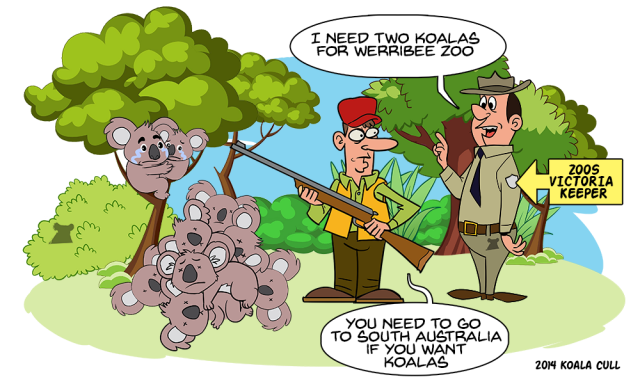
A classic example of a policy that lacked vision, insight and governance was the Victorian Government's Cape Otway koala cull in 2014. The state government, acting on poor advice and wanting a cheap and quick solution to purported koala overpopulation, commissioned the culling of 700-800 koalas in the Cape Otway region. Rather than undertake a project with adequate planning and ethical considerations –perhaps creating or extending a corridor or tourism walkway to showcase some of Australia's koalas - the government, with no to very little knowledge of the situation and circumstances in Cape Otway, needlessly killed hundreds of koalas without any advice from real experts. And, the real experts in this situation are, of course, the people who spend time with koalas on the ground, on a daily basis (either professionals or volunteers); the foot-soldiers who were, once again, ignored and dismissed.
And this is where things get a little strange. While the Victorian government was undertaking its culling campaign, it appears that other factions of the government where not aware of the happenings in Cape Otway. How could the zoological bodies within the government not be aware of this? How is it possible that the left hand did not know what the right hand was doing? And throughout this cruel and unnecessary koala cull, Werribee Zoo were building a new koala enclosure and were trying to source koalas! They ended up sourcing 2-3 koalas from South Australia, and these koalas had to be tested for chlamydia and inbreeding. The staff at Werribee Zoo had no knowledge of the cull taking place until the media coverage exposed the incident in 2015, but they surely would have been able to take some Cape Otway koalas into their institution. I had assumed that one of the primary purposes of Werribee Zoo was to take advantage of new Victorian legislation that permitted the public to hold a koala, while having a photo, similar to Queensland laws and that they would then put the revenue generated from this activity into programs that protected koalas such as the Cape Otway populations.
How the Funk does this happen?
If success is to be achieved, governments and corporations need to ask for assistance, they need to look outside the box for ideas and leadership. Leaning on a diverse range of people with a diverse range of skills will certainly prevent devastating events such as the koala cull of 2014 from happening again. The Victorian Government had years and numerous opportunities to find people with expertise and a solid long-term and short-term vision for the future, yet they chose to ignore it. With all this in mind, the fact remains that we must consider a different approach to koalas in the wild that promotes innovation. We must invite other industries to be part of the change in the koala conservation STORY, and recognise that cheap and quick "fixes" such as culling is no solution at all.
The news in 2015 of the koala cull shows a lack of knowledge by everyone involved. It's an embarrassment to all Australians and reflects poorly on us as a tourism destination. This event has now become embedded in our history and it tells the world that Australia deals with its problems without expert consultation, creativity, long-term planning and without innovation. This secretive behaviour and strategic media release perfectly illustrates the incompetence of the Victoria State government in matters relating to wildlife.
The next article: Article 19, is called "What the Funk Part-3" a five-part series that questions the Victorian government's handling of the secret koala cull in 2014.