
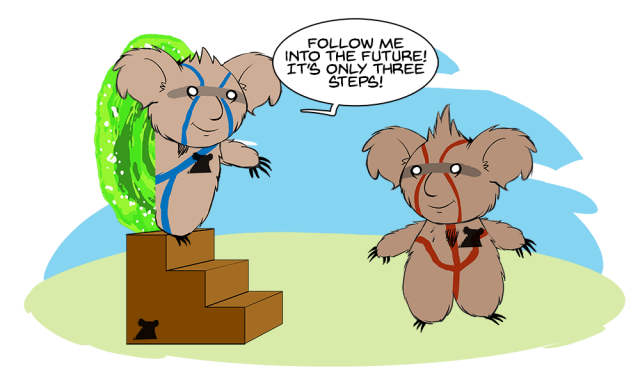
The 3-STEP PROCESS includes mapping and understanding the population of koalas in the wild. The Australian Koala Foundation (AKF) can play a role in this but fall short in managing to prevent koala inbreeding, disease control and the ever-increasing road kill rates. It seems they are leaving this role to the public which shows complacency as they are leaving a wide gap in the three-step process. The first role is played by all levels of government and the third could easily be filled by the captive sector. Though at the start it should be under the jurisdiction of Federal, followed by State and then local to set rules and guidelines as well as a long-term vision shared by all levels of government. They will also need to maintain a clear understanding of every segment along the way and be constantly ensuring effective governance and procedures are taking place to ensure that we can avoid what happened in the state of Victoria in 2014. The Victorian koala cull occurred because there was no long-term vision and a lack of leadership from the AKF, as well as from Victorian zoos who could have provided guidance, but didn't.
The Australian Koala Foundation (AKF) has existed since the 1980's. They were once a small koala group in the Redland City council. They could have named themselves the Redland City Koala Foundation, or the Brisbane or Queensland Koala Foundation, but NO - they called themselves the "Australian Koala Foundation" in a bid to stamp their authority right around the entire country. AKF are more comfortable complaining and campaigning on impulse more than anything else, cherry picking their projects and being very careful not getting their hands dirty. They are raking in tens of millions of dollars along the way and doing virtually nothing constructive other than putting their name to causes that are uncontroversial and would create no negative publicity for them.
Other than working intensively in their own backyard, they have fallen short in other states and territories around Australia while pretending to look the part, relying solely on words and reputation. At the beginning, this tactic had currency, but over time, and with limited amount of imagination and innovation, they have achieved very little. For the survival of the koala, we all need to stay current. We need to reinvent the wheel in terms of the koala story. Everyone has a part to play. And this is not to say that AKF shouldn't be part of the bigger vision – they can still play a role – but they need to know their strengths and weaknesses and should stay away from actually managing koalas in large numbers.
It is important that we set up the right platform and creating a vision where many stories can fit under one umbrella. An inclusive platform. In order to have this, AKF will need to radically change, and this means that they have to introduce the captive sector into the picture. Conservation groups will need to step aside in the short term and allow the captive sector to do what they do so best. Because despite the decreasing age of keepers, there is potential for the captive sector to build a strong platform and attract experienced staff back into the industry because these people are just waiting for the captive and conservation industries to unite with government backing. The expertise is out there waiting to return.
This will take a big, long term vision. The best way forward is to set up a commercial practice with the Federal government where each state government sets their own guidelines. Councils should support the state guidelines - set by the federal vision - on both sides of the political divide, to ensure a different side of the koala is revealed. Because, after all, koalas aren't just sleepy, curled-up balls of fluff; they are active animals and have huge potential when approached with a sense of purpose for both animal and human.
In this new age of technology with a faster and more transparent open society, the AKF is falling behind. Sure, with this new way of living has created a society that is in large parts, disconnected, particularly as we all still are finding out feet in it. However, that is not an excuse. It's a simple process and only our temperaments, ego and status will let us down and get in the way of a potentially great program.
The 3-Step Process are;
Step 1: The State and Federal Governments (overseeing planning and development)
Step 2: The Australian Koala Foundation, and other conservation groups (setting the ground work in mapping and estimating koala numbers).
Step 3: The Captive Sector practices will combine Step 1 and Step 2, together and maintain high standards and constant monitoring.
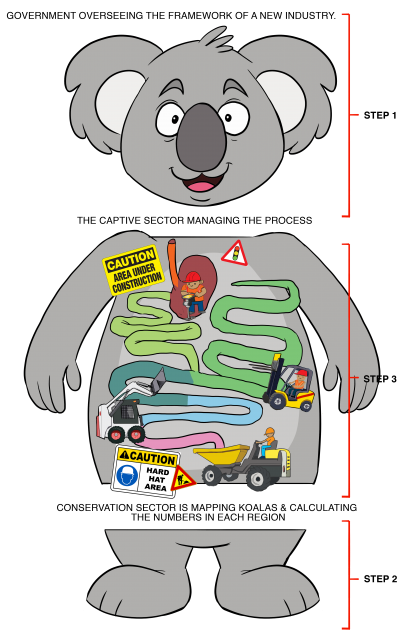
At the moment there is no end game; no plan to finish off what's been started. This is where the captivity sector could support the first two roles of the governmental and the conservation sector. The Australian Koala Foundation, with their mapping, monitoring and assessments, play a role in the initial phase of a project, like the role that an architect plays in the construction of a house.
Unfortunately, the conversation tends to fall apart when the AKF and the government work directly together with no outside support. Essentially, they are missing Step 3. And as AKF have reached their limit in terms of understanding the next phase of the operation, they risk leaving a wide gap for the Victoria government to fill. AKF are asking too much of the Victorian State Government. Essentially, the end game of the process is still missing and has yet to be finished. The AKF are great at laying the foundations, while the government is proficient at overseeing the implementation phase. However, there is a lack of overall knowledge, limited expertise and a narrow pool of people with diverse opinions who can assist in Step 2. It is, unfortunately, as they rely on Universities or individuals-with now to little actual understanding of the needs of koalas in the field, it's a case of the blind leading the blind.
Thus, Step 3 (the role of the captive sector) is of vital importance in any project involving the koala, and, if it were not overlooked, the koala cull could have been avoided. The captive sector with its range of experts, field workers and staff with long-term hands on experience, can play a crucial role as an intermediary between AKF and the Victorian State government.
The next article: Article 21, "Connecting the dots" is Part-5 of the secret koala cull in 2014,
52 Articles, 4 themes 1 story